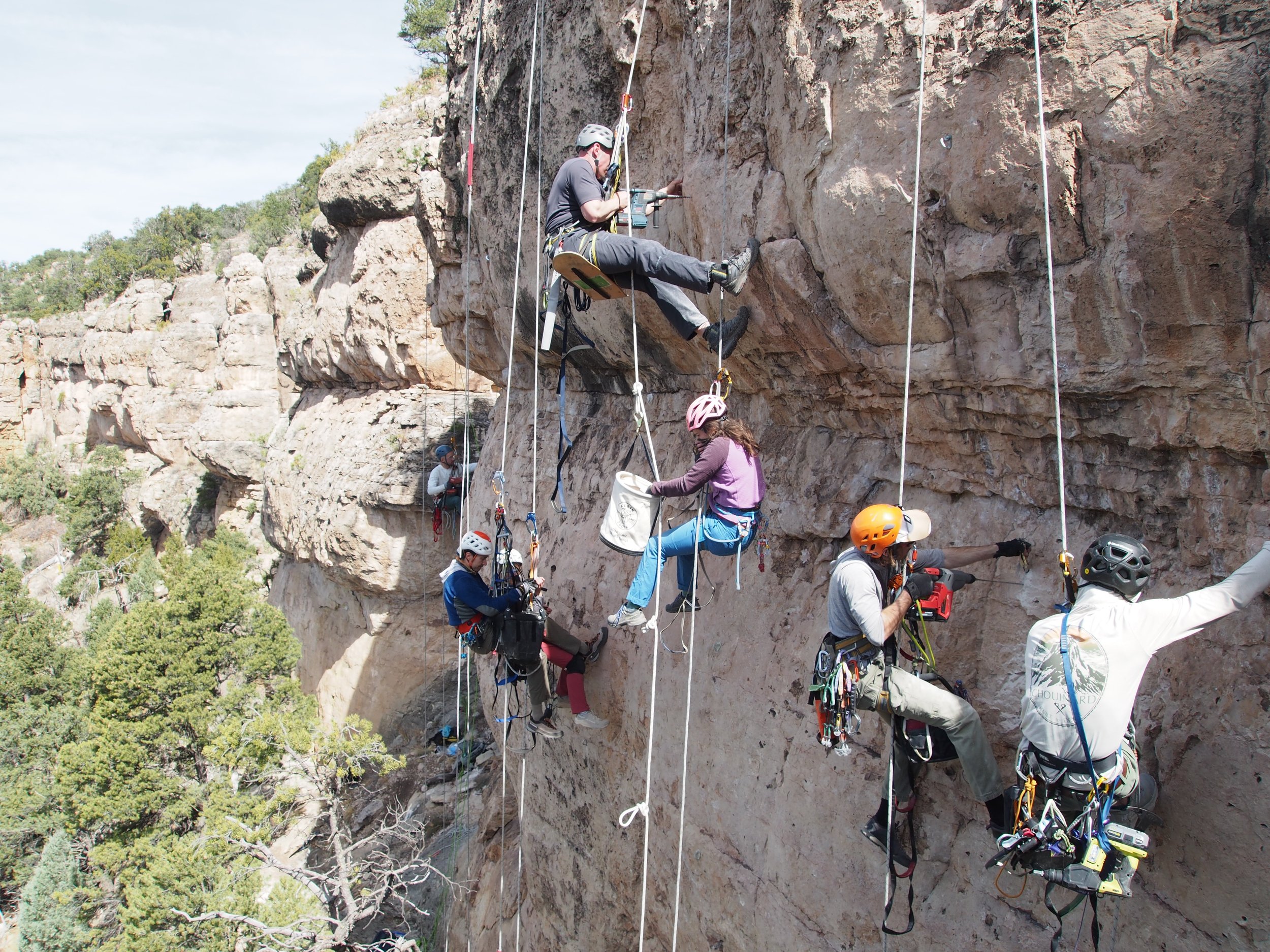
Boulder Climbing Community and Pike’s Peak Climbers Alliance volunteers rebolting at Shelf Road this past March
Several federal agencies have recently issued draft policies relating to climbing, especially fixed anchors. Some of these have particular significance for the BCC’s geographic area of focus. The BCC has been following these issues closely and has often represented local climbers' interests on them. We expect to submit comments to the relevant agencies and encourage local climbers to submit their own comments if they wish.
The US Forest Service directive [Click Here] on non-wilderness areas would cover many local climbing areas, including much of Boulder Canyon, St. Vrain Canyon, the South Platte (including Devil’s Head), and many crags from Allenspark to Estes Park. The USFS directive does not propose specific new climbing rules but instead encourages local USFS offices to develop their own climbing management plans, which could contain significant new climbing restrictions. In general, we think this is a reasonable approach, but the ultimate outcome depends heavily on what the local offices decide. The BCC has worked extensively to develop good working relationships with local USFS offices.
The USFS directive also addresses wilderness areas, which include Mount Blue Sky, James Peak/Indian Peaks, and other nearby wilderness areas with some climbing. Most notably, it would allow local officials to remove existing fixed anchors if they “are no longer consistent with preservation of wilderness character.” It encourages local USFS offices to develop climbing management plans for wilderness areas and “allow for placement and replacement of fixed anchors and fixed equipment where consistent” with those plans.
The National Park Service has issued guidance [Click Here] that applies only to wilderness areas, not to all NPS properties with climbing. Locally, that includes most of Rocky Mountain National Park; nationally, it would include Yosemite and much of Joshua Tree. NPS would adopt a major change for new fixed anchors — approval is required by the affected park. Each affected park must develop a plan governing climbing, but, until then, may approve new fixed anchors on a case-by-case basis. The NPS does not detail the criteria to be used in deciding whether to approve a new fixed anchor. However, consistent with the Protect America’s Rock Climbing Act, it precludes parks from using the very strict Minimum Requirements Analysis. It would allow the “occasional placement of a fixed anchor” but directs that “climbing practices with the least negative impact on wilderness resources and character will always be the preferred choice.” Routes existing before 2025 are generally preserved, where consistent with wilderness character. Each park may choose to require approval for the replacement (or removal) of existing fixed anchors. The NPS would preclude “bolt-intensive face climbs” but is not clear whether this concerns existing routes, or just new routes. It bans gluing, chipping, and damaging or removing vegetation around climbs.
Comments on the USFS directive are due by July 18, and on the NPS guidance by August 14. Comments may be made directly to the USFS [HERE], NPS [HERE] or through Access Fund’s portal: Take Action.
In addition, both the Bureau of Land Management [HERE] and the US Fish and Wildlife Service [HERE] have issued proposals governing climbing on their wilderness areas. Neither agency has a wilderness area with climbing on the Front Range, so the BCC is not detailing those proposals. Interested climbers should read the linked documents and comment before August 14.